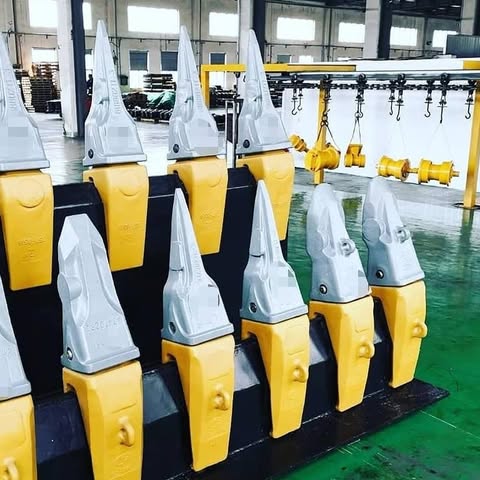
How Can Bucket Teeth Perform Better in Aggregate Yards?
Bucket teeth for excavator replacement perform better in aggregate yards when the tooth profile, adapter, locking system, and material grade match the machine and the working face. Choose penetration for compacted material, impact resistance for blasted rock, and a balanced profile for mixed stockpiles. Correct fit, timely inspection, and controlled digging angles usually matter as much as the tooth itself.
- Match the tooth system to machine class, bucket interface, and aggregate conditions rather than buying by appearance alone.
- Use pointed profiles for penetration, heavier profiles for impact, and balanced profiles for mixed excavation and loading.
- Inspect the tooth, adapter, pin, and lock as one wear system because a loose connection can accelerate damage.
- Evaluate heavy equipment wear parts wholesale purchases by service life, downtime exposure, and replacement convenience—not unit price alone.
Aggregate yards place ground engaging tools under a changing mix of abrasion, impact, vibration, and side loading. Excavator teeth are the first contact point with the material, and industry guidance explains that they concentrate breakout force into a smaller contact area. The practical result is simple: a tooth that penetrates well in compacted feedstock may wear too quickly in blasted stone, while an overly heavy tooth may reduce digging efficiency in less resistant material. This guide explains how to select, inspect, and manage replacement teeth for quarry stockpiles, recycling yards, sand and gravel operations, and general earthmoving.
1. Start with the Aggregate Yard Duty Cycle
The working material should determine the tooth priority before a replacement part is selected. Aggregate yards rarely present one uniform condition. A machine may loosen compacted fines in the morning, handle blasted rock later, and load processed stone at the same location.
| Work condition | Primary risk | Tooth priority | Editorial priority score, 1-5 |
|---|---|---|---|
| Compacted soil or clay | High penetration resistance | Sharper entry and efficient penetration | Penetration: 5 |
| Blasted rock | Impact and fracture loading | Reinforced profile and impact resistance | Impact: 5 |
| Loose gravel | Rapid material handling cycles | Balanced wear and loading efficiency | Balance: 4 |
| Recycled aggregate | Unexpected hard inclusions | Durability with secure retention | Retention: 5 |
The scores in this table are a selection framework, not a manufacturer specification. They help a fleet manager rank competing requirements when no single tooth can optimize every task.
2. Select the Correct Tooth Profile
Tooth geometry controls how the bucket enters the material and how much material is carried through the cut. A pointed tooth generally supports penetration in softer or compacted ground, while a wider or heavier profile can provide more working material and resistance to impact in hard aggregate.
Pointed profiles are useful when breakout resistance is the main limitation. Search-based technical guidance from GFM Parts describes pointed teeth as suitable for faster penetration in soft soil and reduced digging resistance. In an aggregate yard, that logic can also apply to compacted fines, clay seams, and material that has settled tightly in a stockpile.
Heavy-duty profiles are preferable when impact and abrasion dominate. Rock handling can expose the front of the tooth to repeated shock loads, and a narrow, aggressive point may lose its shape quickly if it is used to pry or strike large fragments. A heavier profile may deliver a better service-life balance even if its initial penetration is less aggressive.
General-purpose profiles are often the safest choice for mixed work. If one excavator moves between loading, cleanup, trenching, and stockpile management, a balanced tooth can reduce the cost and inconvenience of changing configurations for every task.
3. Treat the Tooth, Adapter, Pin, and Lock as One System
Replacement teeth perform reliably only when the complete attachment system is compatible. The adapter transfers force from the tooth into the bucket lip, while the pin and lock prevent the tooth from separating under vibration and reversing loads.
| Component | What to verify | Failure signal | Inspection order |
|---|---|---|---|
| Tooth | Profile, nose fit, wear symmetry | Thin tip, cracking, excessive rounding | 1 |
| Adapter | Bucket lip fit, nose condition, weld area | Movement, distortion, weld cracking | 2 |
| Pin | Correct diameter, seating, retention | Backing out, deformation, looseness | 3 |
| Lock | Correct system and secure engagement | Missing or damaged retainer | 4 |
The inspection order is a practical four-step sequence rather than a universal replacement interval. It prevents a common purchasing mistake: replacing a tooth while leaving a worn adapter or damaged locking component in service.
Brand compatibility does not guarantee complete interchangeability. Confirm the excavator model, operating class, bucket lip dimensions, adapter nose, pin arrangement, locking direction, and tooth orientation. The Cutting Edges profile guide also emphasizes that tooth size must match the intended machine and bucket system.
4. Improve Performance Through Correct Operating Technique
Operating technique can extend tooth usefulness because side loading and prying often create damage that material hardness alone does not explain. The bucket should enter the working face with the tooth line aligned to the intended cut, and the operator should avoid using the tooth as a lever against oversized rocks whenever possible.
- Use the bucket’s breakout force to penetrate rather than repeatedly striking the same point.
- Avoid excessive side loading when the tooth is only partially engaged.
- Do not drag a heavily loaded bucket across hard ground when the task is loading rather than grading.
- Keep the tooth line and adapter free from packed material that can prevent full seating.
- Investigate sudden looseness immediately; continued operation can damage the adapter and bucket lip.
A smooth bucket is normally more suitable for grading, cleanup, and controlled material handling, while a tooth bucket is designed for digging and penetration. The comparison from Tomahawk Attachments explains that teeth concentrate machine breakout force at the initial contact point. In an aggregate yard, that distinction helps determine whether the machine is being asked to dig, load, spread, or finish.
5. Build a Practical Wear Inspection Program
Frequent visual checks are more valuable than waiting for a tooth to fail because wear changes the tooth shape, fit, and force path progressively. A fleet can use the following five-point inspection after a shift or whenever the machine moves to a different material zone.

- Compare the working tip with a new or known-good tooth.
- Check whether the tooth remains fully seated on the adapter.
- Look for adapter nose wear, lip cracking, and weld damage.
- Confirm that the pin and lock remain present and correctly engaged.
- Record the material handled, visible wear pattern, and replacement reason.
Uneven wear is a diagnostic clue rather than merely a cosmetic issue. Wear concentrated on one side may indicate side loading, a bent adapter, an alignment problem, or an operating pattern that keeps the bucket at an angle. Rapid tip loss may indicate that a penetration-focused profile is being used in an impact-heavy application.
6. Compare Total Cost Instead of Unit Price
The lowest purchase price is not necessarily the lowest operating cost. A sound purchasing comparison combines part price, expected service duration, installation effort, freight, stock availability, and the cost of an unplanned machine stoppage.
| Cost factor | Option A: lower initial price | Option B: higher durability focus | Decision question |
|---|---|---|---|
| Purchase price | Lower | Higher | Does the price difference reflect useful material or fit? |
| Replacement frequency | Potentially higher | Potentially lower | What wear pattern is documented in this application? |
| Downtime exposure | May increase with short stock | May decrease with planned stock | Can a replacement be installed before failure? |
| Compatibility risk | Depends on verification | Depends on verification | Are dimensions and retention details confirmed? |
These columns describe a procurement method, not a promise that one option will always last longer. Request drawings, material information, inspection records, and fit confirmation from a ground engaging tools manufacturer before approving a large order. Pre-delivery inspection, drawing approval, and test documentation can reduce risk for overseas buyers and fleet operators managing multiple machine models.
7. A Purchasing Checklist for Replacement Teeth
A documented specification makes replacement purchasing faster and reduces the chance of receiving a visually similar but incompatible part.
- Machine make, model, operating class, and bucket capacity.
- Adapter type, tooth series, pin style, and lock style.
- Bucket lip dimensions, tooth orientation, and interface measurements.
- Primary material: soil, gravel, blasted rock, recycled aggregate, or mixed feed.
- Required performance priority: penetration, impact resistance, abrasion resistance, or balanced use.
- Quantity required, packaging expectations, and target delivery schedule.
- Inspection documents, dimensional confirmation, and replacement support.
Frequently Asked Questions
1. Which bucket teeth are best for aggregate yards?
The best choice depends on the material and duty cycle. Use a penetration-focused profile for compacted soil, a heavier impact-resistant profile for blasted rock, and a balanced profile for mixed loading and excavation.
2. Are pointed teeth always more productive?
No. Pointed teeth can enter resistant or compacted material efficiently, but they may wear faster under severe impact or abrasive rock. Productivity must be evaluated with wear life and machine downtime.
3. Can I fit any replacement tooth to the same excavator?
No. Compatibility depends on the bucket adapter, tooth series, pin and lock system, dimensions, and orientation. Confirm the complete interface before ordering.
4. When should an adapter be replaced with the tooth?
Replace or repair the adapter when it allows excessive movement, shows serious nose wear, has damaged retention areas, or exhibits lip or weld damage. A new tooth cannot correct a failed adapter.
5. How can operators reduce premature tooth wear?
Align the tooth line with the cut, avoid unnecessary side loading and prying, keep the tooth seated, and select a profile suited to the material rather than using one design for every task.
6. Should an aggregate yard use a smooth bucket?
A smooth bucket can be useful for grading, cleanup, and controlled loading. A toothed bucket is generally better for digging, breaking compacted material, and entering a hard stockpile. Many operations need both configurations.
7. What should wholesale buyers request from a supplier?
Request compatibility confirmation, drawings or dimensional data, material and quality information, retention details, packaging requirements, and a clear process for resolving fit or performance issues.
About Our Ground Engaging Tools Supply
Excavator Spares supports buyers evaluating bucket teeth, adapters, pins, locks, cutting edges, undercarriage components, and other heavy equipment wear parts. Our approach focuses on application matching, interface verification, consistent communication, and practical replacement planning. For a quotation or compatibility review, visit the Excavator Spares website and provide the machine model, bucket details, working material, and required quantity.
Conclusion
Better bucket-tooth performance comes from treating the tooth as part of a complete wear system. Match the profile to the material, confirm the adapter and retention system, train operators to limit damaging side loads, and compare total operating cost rather than unit price alone. These steps help aggregate yards improve penetration, control wear, and reduce avoidable interruptions without assuming that one tooth design suits every machine or stockpile.